Monday, February 5

February Harvest

The gloom lifted for a while on Sunday, so wrapped in several layers of clothing we headed for the allotment.

We had wondered whether we would be faced with any damage as we hadn't managed to make a plot visit since before the period of stormy weather. Happily the worst casualty was one of the sweet pea frames which had developed a lean.
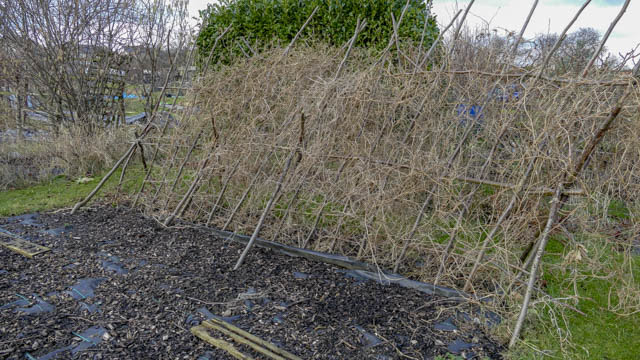
Clearing the dead sweet peas will be a job for another day.

Our cache of vegetables had run out so our first priority was to make sure we gathered plenty of vegetables to take home.

Martyn set to digging parsnips and carrots whilst I dug leeks, picked sprouts and managed to find a small amount of pak choy.
Some of the parsnips were huge but many were afflicted with canker. We grow Gladiator, reputed to be a canker resistant variety but this doesn't make them immune. Fortunately there is usually plenty of unaffected parsnip flesh but it does mean that our parsnips, just like the carrots, will never win any beauty competitions.

Our pak choy is always well nibbled but I managed to find enough to add to an egg fried rice dish for Monday.

Another job that was in urgent need of completion was spraying the fruit trees with a winter wash. We went through a period when plum tree aphids devastated our plum trees causing all the leaves to shrivel. The trees  looked as though they were dying and produced no fruit. Later in the year a new set of leaves grew but the damage to any potential crop was already done. Every year since we have treated the trees to a winter wash.
This can't be left too late as spraying has to be completed before any buds burst. Ideally the trees should be sprayed twice but more often than not they have to make do with just one dose.

A quick look round the plot shows that some fruit bushes are already primed for action.
I decided to try and tidy up some of the clumps of rhubarb. One of the largest clumps had formed a sort of fairy ring.
I guess this is a hint that it needs splitting.

This week I am linking to harvest Monday hosted on 
Dave's blog Our Happy Acres


Friday, February 2

RSPB Big Garden Birdwatch

Like many others, Martyn and I took part in this year's RSPB Big Garden Birdwatch.

Our garden isn't very large but it is impossible to cover the whole garden with just two pairs of eyes so we concentrate on the area to one side of our house. It's where the bird feeders and tables are and also the most popular bird bath. It's also an area that we often look out on after the feeders and tables have been topped up. That's Martyn's first job after breakfast and if he is late there is usually a queue of blackbirds positioned nearby waiting to swoop down the minute he returns to the house. They also often perch round the back of the house watching the kitchen door and following him round the house as he heads for their favourite bird table. The most vigilant bird has first pick of the food.

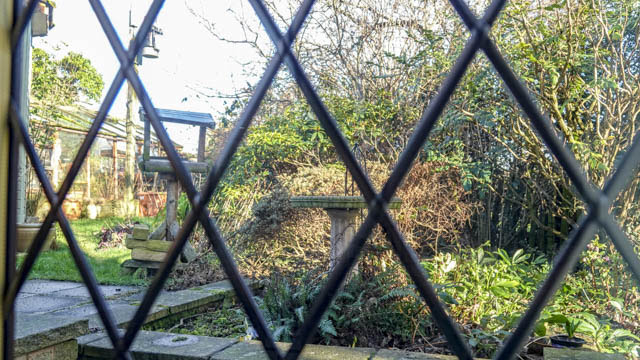
Two of our house windows overlook this area and so Martyn is on lookout at one.
I am stationed at the other.
At any one time the conversation goes:
"I've two blackbirds."
"I've three."
So that's five in total.

The birds tend to come in waves and so really once the first wave has passed we rarely beat the original numbers counted - that is until the next wave which is usually outside of the chosen hour. It's most frustrating when frequent visitors fail to make an appearance during the count.

On Saturday where were the almost ever present wood pigeons?
Then there were the three magpies that showed up on the wrong day.
Of course none of the more sporadic visitors deigned to call.

No long tailed tits turned up. A stray did however, pay us a fleeting visit on Tuesday.
If a coal tit turned up we missed it, as it tends to do quick dash and grab of a sunflower heart, this could easily be the case.
The greenfinches kept a low profile and no bullfinches graced us with their presence.
So which birds actually did turn up on Saturday morning?
The RSPB semi doughnut chart showed our results like this.
There were maybe more house sparrows than we counted as they were hopping around in the trees and flying to and from various feeding locations. The trouble is birds just don't sit still!  Going on regular observations I would have expected the goldfinch to come out as second highest visitor.

It's really difficult to image that only one great tit and two blue tits paid us a visit. Like the coal tit unless they fancy feeding from the peanut or suet, they tend to flit backwards and forwards so our one great tit could in fact have been several individuals.

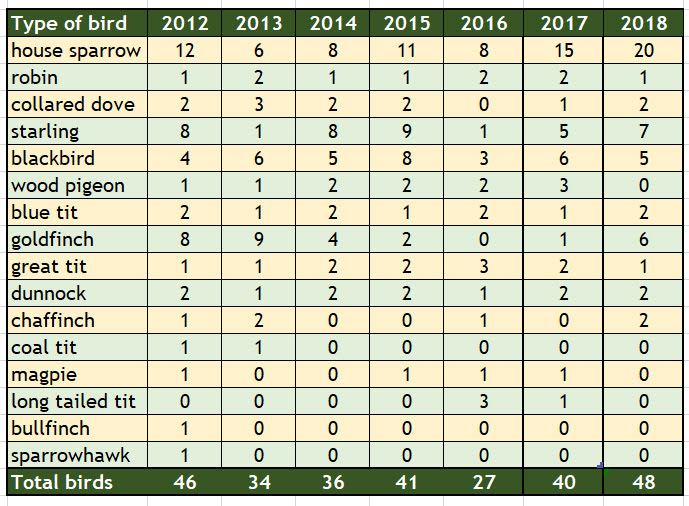
Over the past few years I have kept the results of our bird count on a spreadsheet.
The above data is shown as a graph below.
We had intended to do a recount on Monday morning as a comparison but it was a very dull and wet morning and just like us the birds were not venturing out.

Another weather related issue is that on a dull day many birds can only be seen in silhouette which makes identification challenging. This is specially true of birds flitting about in the trees

It just further shows that the weather conditions can affect the results of the count so maybe we should make a note of that too.

Did you take part in the count and if so what were your observations?


Wednesday, January 31

Portrait of a clivia